You Won’t Believe What Samarkand’s Ancient Walls Have Seen
Walking through Samarkand feels like stepping into a living storybook. The air hums with history, and every tile tells a tale. I never expected to feel so connected to a place so far from home. From grand mosques to quiet courtyards, the cultural venues here don’t just impress—they speak. If you’re looking for depth, beauty, and authenticity, this city delivers. Let me take you through the heart of Uzbekistan’s soul, where past and present dance in golden light.
First Glimpse: Arriving in Samarkand – A City That Feels Like a Dream
As the morning sun rises over the Koshk River, Samarkand awakens in soft golden hues. The first view of the city from the eastern entrance reveals a skyline punctuated by turquoise domes and towering minarets, rising like sentinels from a bygone era. The scent of baking bread and blooming jasmine drifts through the air, mingling with the faint murmur of early risers sweeping courtyards and merchants arranging melons and dried apricots in open markets. This is not a museum exhibit—it is life unfolding within ancient walls.
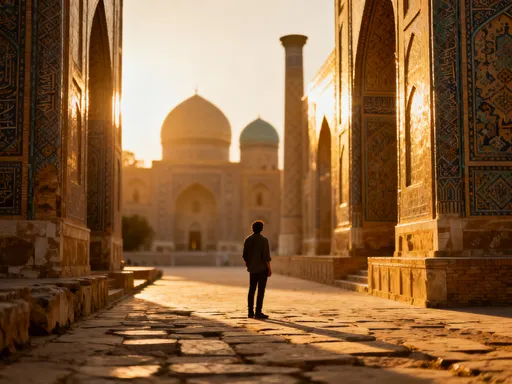
For many travelers, the emotional impact begins the moment they step onto Registan Square, even before fully understanding its historical weight. The sheer scale and artistry of the three madrassahs—each a symmetrical masterpiece—create a sense of awe that words often fail to capture. But beyond the postcard image, what truly stirs the heart is the quiet hum of continuity. Children walk to school beneath arched portals where scholars once debated astronomy; elderly men sip green tea on benches placed exactly where caravans once rested.
Samarkand’s magic lies in this seamless blend of the monumental and the everyday. Unlike cities where heritage is cordoned off behind velvet ropes, here history lives in the rhythm of daily routines. Women in floral scarves knead dough in clay ovens near 14th-century mosques. Artisans tap chisels against stone in courtyards that have echoed with similar sounds for centuries. The city does not perform for tourists—it simply exists, gracefully, in its layered identity.
Located in southeastern Uzbekistan, Samarkand stands as one of Central Asia’s most enduring cultural beacons. Its position along the Silk Road made it a crossroads of ideas, goods, and faiths for over two thousand years. While empires rose and fell, the city remained a center of learning, trade, and spiritual life. Today, visitors from around the world come not only to admire its architecture but to feel the pulse of a civilization that has weathered time with dignity and grace.
Registan Square: The Beating Heart of Islamic Scholarship and Art
At the core of Samarkand’s legacy stands Registan Square, a UNESCO World Heritage Site and one of the most breathtaking public spaces in the Islamic world. Composed of three grand madrassahs—Ulugh Beg Madrassah, Sher-Dor Madrassah, and Tilya-Kori Madrassah—the square forms a harmonious ensemble of symmetry, color, and intellectual ambition. Each structure, though built across different centuries, contributes to a unified vision of knowledge, faith, and artistic excellence.
The oldest of the three, the Ulugh Beg Madrassah, was constructed between 1417 and 1420 under the patronage of Timur’s grandson, a ruler whose passion for science rivaled his political power. Far from being merely religious schools, these institutions were centers of higher learning where astronomy, mathematics, medicine, and philosophy were studied with rigor. Ulugh Beg himself was a renowned astronomer who built an observatory nearby and calculated the length of the solar year with remarkable accuracy—long before European telescopes existed.
The architecture of the madrassahs reflects this intellectual spirit. Every tile, arch, and inscription serves both aesthetic and symbolic purposes. The intricate geometric patterns on the walls are not random decorations; they represent the Islamic understanding of divine order and the infinite nature of creation. Calligraphy bands in Kufic and Thuluth scripts display verses from the Quran and sayings of the Prophet, reinforcing the sacred purpose of these spaces.
One of the most striking features of Registan is its acoustic design. Standing at the center of the square, a person speaking in a normal voice can be heard clearly on the upper floors of the surrounding buildings—a testament to the advanced engineering of the time. This was no accident; it allowed scholars and teachers to lecture to students gathered in the courtyard without amplification.
The Sher-Dor Madrassah, built in the 17th century, introduces a more decorative style with its iconic mosaics of tigers chasing suns, a rare depiction of living creatures in Islamic religious architecture. While some interpret the tigers as symbolic representations of power and vigilance, others see them as artistic license during a period of shifting cultural norms. Regardless, their presence adds a dynamic energy to the square, contrasting with the more austere elegance of Ulugh Beg’s original structure.
Today, Registan is not only a tourist destination but also a venue for cultural festivals, traditional music performances, and national celebrations. At night, the entire complex is illuminated in a soft golden glow, transforming the square into a luminous dreamscape. Yet even amidst the modern lighting and crowds, the silence between footsteps still carries the whispers of scholars long gone.
Beyond the Postcard: Exploring Bibi-Khanym Mosque and Its Hidden Stories
Just a short walk from Registan lies the grand Bibi-Khanym Mosque, once one of the largest mosques in the Islamic world. Commissioned by the conqueror Timur (Tamerlane) in the late 14th century upon his return from India, the mosque was intended to reflect his power and devotion. According to legend, Timur ordered the construction to be so swift that builders worked day and night, using elephants to transport massive stone columns. The main dome was said to have been suspended in midair during construction—an engineering feat that, while possibly exaggerated, speaks to the ambition behind the project.
Though time and earthquakes have taken their toll, the remaining structures still convey the original grandeur. The towering entrance portal, or pishtaq, rises over 35 meters, adorned with intricate blue mosaics that shimmer under the sun. Inside the courtyard, four minarets mark the corners, and the vast prayer hall—though partially ruined—once accommodated up to ten thousand worshippers.
One of the most moving elements of the mosque is the stone lectern, said to have held a Quran so large that it required several people to turn its pages. This Quran, gifted by Timur from his conquests, symbolized both spiritual authority and imperial reach. Though the original manuscript is now preserved elsewhere, the stone stand remains, worn smooth by centuries of reverence.
What makes Bibi-Khanym especially meaningful today is how locals continue to use the complex. While parts are maintained as a historical site, designated areas remain active for prayer, especially during Friday services. Visitors often pause to watch elderly men unfurl prayer mats beneath shaded arcades, their quiet devotion a living link to the past. This coexistence of preservation and practice gives the site a depth that goes beyond architectural admiration.
For respectful visitation, modest dress is essential—shoulders and knees covered, with headscarves for women when entering prayer zones. Photography is permitted in most areas, but discretion is advised during prayer times. Early morning or late afternoon offers the best light for photos and the most peaceful atmosphere, with fewer crowds and cooler temperatures.
The ongoing restoration efforts at Bibi-Khanym reflect Uzbekistan’s commitment to honoring its heritage. Using traditional materials and techniques, artisans painstakingly recreate missing tilework and reinforce fragile walls. These projects not only preserve history but also pass down skills that might otherwise be lost.
Shah-i-Zinda: A Spiritual Walk Through Tile-Covered Tombs
Nestled along the slopes of ancient Afrosiab Hill, the Shah-i-Zinda necropolis is one of Samarkand’s most spiritually resonant sites. The name means “The Living King,” referring to Kusam ibn Abbas, a cousin of the Prophet Muhammad, who is believed to have brought Islam to the region in the 7th century. According to tradition, he was martyred here but continues to live in the spiritual realm, making the site a pilgrimage destination for centuries.
The pathway ascends in a series of staircases flanked by over twenty mausoleums, each more dazzling than the last. The walls and domes are covered in radiant mosaics of lapis lazuli blue, emerald green, and ivory white, forming stars, flowers, and sacred inscriptions. The effect is otherworldly—like walking through a corridor of light and color, where every turn reveals a new masterpiece of ceramic art.
Each mausoleum tells a story. Some were built for members of Timur’s family, others for high-ranking officials or revered scholars. The Gulbakhram Mausoleum, with its delicate lattice patterns, honors a noblewoman whose name means “heart’s joy.” The Shadi Mulk Aka Mausoleum, adorned with deep cobalt tiles, features some of the finest examples of 14th-century craftsmanship. The interplay of light and shadow across the glazed surfaces changes throughout the day, giving the site a living, breathing quality.
Visitors often walk in quiet reverence, many touching the cool tile walls or pausing to recite prayers. The atmosphere is contemplative, a stark contrast to the bustling energy of Registan. Families come to honor ancestors, and women leave small offerings of bread or cloth near certain tombs believed to have healing properties.
For photographers, the late afternoon offers the most magical lighting, as the setting sun bathes the upper mausoleums in golden warmth. However, visitors are encouraged to be mindful—this is an active place of worship, not a stage for posed shots. Flash photography and loud conversations are discouraged, especially near active prayer areas.
Shah-i-Zinda is more than a collection of tombs; it is a testament to the enduring power of faith and memory. In a world that often moves too fast, this sacred lane invites stillness, reflection, and connection across generations.
Local Culture in Action: Craft Workshops and Living Traditions
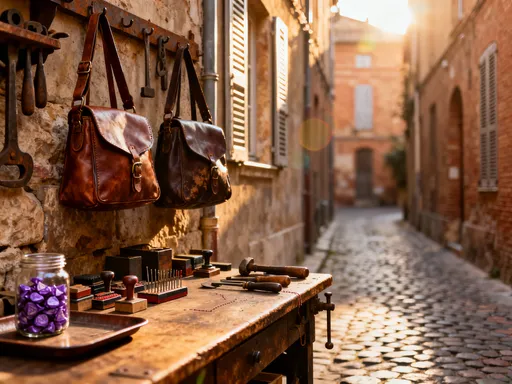
While Samarkand’s monuments speak of the past, its living traditions keep history alive in the present. Scattered throughout the city and nearby villages are workshops where artisans practice crafts passed down through generations. These are not tourist performances—they are real livelihoods, sustained by skill, patience, and pride.
One of the most remarkable is the Meros Paper Mill, located just outside the city. Here, craftsmen produce paper using methods that date back over a thousand years. Made from mulberry bark, the paper is hand-stripped, boiled, beaten, and dried under the sun. The result is a durable, textured sheet that was once used for royal decrees and sacred texts. Visitors can try their hand at papermaking, feeling the fibers form beneath wooden presses and gaining a new appreciation for the labor behind every sheet.
In the nearby town of Rishtan, ceramic artists create the famed blue-glazed tiles that adorn Samarkand’s buildings. Using natural pigments and wood-fired kilns, potters shape, carve, and glaze their works with precision. The cobalt blue, derived from locally sourced minerals, has become synonymous with Central Asian design. Tourists can visit studios, watch demonstrations, and even paint their own tiles under guidance.
Within Samarkand’s homes, women continue the tradition of silk embroidery, creating intricate patterns on dresses, scarves, and household textiles. These designs often carry symbolic meanings—pomegranates for fertility, cypress trees for eternity, floral motifs for prosperity. Some families welcome visitors into their homes for tea and stitching sessions, offering a rare glimpse into domestic life and the quiet artistry that defines it.
Supporting these artisans is not just a shopping opportunity—it is an act of cultural preservation. When travelers purchase handmade paper, ceramics, or textiles directly from creators, they help sustain communities and ensure that these traditions survive. Many workshops now offer certificates of authenticity and explain the history behind each craft, deepening the connection between buyer and maker.
These experiences remind us that culture is not only in stone and scripture but also in hands that shape, weave, and create. In a world of mass production, Samarkand’s crafts offer something rare: authenticity, soul, and continuity.
Navigating Samarkand: Practical Tips for a Meaningful Visit
Planning a trip to Samarkand requires thoughtful preparation, not because the city is difficult to access, but because its richness deserves more than a rushed tour. The best time to visit is between April and June or September and early October, when temperatures are mild and the skies are clear. Summers can be hot, with daytime highs exceeding 95°F (35°C), while winters are chilly, especially in January and February.
Most international visitors arrive via Tashkent, Uzbekistan’s capital, and take a high-speed Afrosiyob train to Samarkand. The journey takes about two hours and offers scenic views of the Zarafshan Valley. Within the city, taxis are widely available and affordable, though it’s wise to agree on a fare before departure. Shared minibuses, known as marshrutkas, connect major sites but may be less comfortable for first-time travelers.
When visiting religious sites like Bibi-Khanym Mosque or Shah-i-Zinda, modest dress is required. Women should wear long skirts or pants and long-sleeved tops, with a scarf to cover the head. Men should avoid shorts and sleeveless shirts. Shoes must be removed before entering prayer halls, so wearing slip-on footwear is convenient.
Language can be a minor barrier, as English is not universally spoken. However, many younger locals and tour guides communicate well in English, Russian, or even basic phrases in other languages. Carrying a translation app or a small phrasebook can ease communication. Simple greetings like “Salom” (hello) and “Rahmat” (thank you) go a long way in building goodwill.
Hiring a certified local guide enhances the experience significantly. A knowledgeable guide can explain historical context, share stories not found in guidebooks, and help navigate cultural nuances. Many specialize in architecture, Islamic art, or Silk Road history, offering tailored insights that enrich the journey.
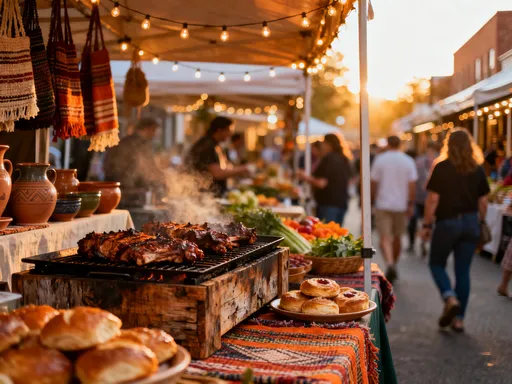
For dining, seek out family-run cafes rather than tourist-focused restaurants. Try plov, the national dish of rice, carrots, and lamb, often cooked in large cauldrons over open fires. Samsa, flaky pastries filled with meat or pumpkin, are best enjoyed fresh from roadside ovens. Prices are generally low, but it’s wise to confirm costs before ordering, especially in areas frequented by tourists.
Respectful behavior—such as asking permission before photographing people, avoiding public displays of affection, and speaking quietly in sacred spaces—ensures a positive experience for both visitors and locals. Samarkand welcomes travelers with warmth, and returning that respect deepens the connection.
Why Samarkand Matters: Where Civilizations Meet and Memories Stay
Samarkand’s enduring significance lies in its role as a bridge—between East and West, past and present, faith and reason. For over two millennia, it has stood at the crossroads of the Silk Road, where Persian scholars exchanged ideas with Chinese traders, Turkic warriors settled beside Arab clerics, and Mongol conquerors became patrons of Islamic art. This confluence did not erase identities; instead, it wove them into something richer, more complex, and uniquely resilient.
The city’s monuments are not relics of a single culture but testaments to synthesis. The calligraphy on Registan’s walls blends Arabic script with Persian poetic traditions. The engineering of Ulugh Beg’s observatory reflects Greek, Indian, and Islamic astronomical knowledge. Even the food—spiced rice, dried fruits, fermented drinks—carries flavors from across Asia, adapted and perfected over centuries.
But beyond its historical importance, Samarkand offers a deeply human experience. It reminds us that beauty, knowledge, and faith can flourish even in turbulent times. It shows how civilizations can learn from one another, not through conquest alone, but through dialogue, trade, and shared aspiration.
For the traveler, especially one seeking meaning beyond the surface, Samarkand invites a different kind of journey—one of listening, observing, and reflecting. It asks not just to be seen, but to be felt. In the quiet of a tile-covered courtyard, the echo of a prayer, or the touch of handmade paper, there is a sense of continuity—that what we value today—creativity, connection, resilience—has been cherished for generations.
As the sun sets over the domes of Registan, casting long shadows across the square, one realizes that Samarkand is not merely a destination. It is a conversation across time. And in that conversation, every visitor becomes a part of its living story.