Walls That Whisper History: Istanbul’s Soul Lives in Its Architecture
You know what? Walking through Istanbul feels like flipping through the pages of a living history book. Every corner tells a story—not just in words, but in stone, dome, and tile. I didn’t expect to feel so moved by buildings, but here’s the thing: Istanbul’s architectural wonders aren’t just stunning to look at—they’re cultural heartbeats. From Byzantine churches to Ottoman mosques, each structure carries centuries of tradition, faith, and artistry. This is more than sightseeing—it’s a journey into the soul of a city where East meets West, not on a map, but in mortar and memory.
The City Where Continents Converge
Istanbul stands as one of the few cities in the world that straddles two continents—Europe and Asia—connected by the shimmering waters of the Bosphorus Strait. This unique geographical position has made it a natural crossroads for civilizations, trade routes, and cultural exchange for over two thousand years. Founded as Byzantium in the 7th century BCE, then refounded as Constantinople by Emperor Constantine in 330 CE, and later transformed into Istanbul after the Ottoman conquest in 1453, the city has continuously reinvented itself while preserving layers of its past. Its skyline, where minarets rise beside modern towers and ancient fortifications guard the shoreline, reflects this rich, layered identity.
Each empire that ruled Istanbul left an indelible mark on its urban fabric. The Romans introduced aqueducts and expansive public spaces. The Byzantines built grand churches and defensive walls that still stand today, such as the impressive Theodosian Walls stretching across the city’s western edge. Then came the Ottomans, who reshaped the city’s spiritual and architectural landscape with mosques, madrassas, caravanserais, and public baths. The result is a city where history is not confined to museums—it is embedded in the very streets, squares, and structures that residents walk past every day.
Walking through districts like Fatih, Sultanahmet, or Karaköy, one can sense the quiet pulse of centuries. The Golden Horn curves like a silver ribbon through the city, once bustling with Byzantine galleys and Ottoman trading vessels, now lined with restored historic buildings and quiet ferry docks. Modern trams glide over cobblestones laid generations ago, and the call to prayer echoes from mosques built upon the foundations of former churches. This seamless blending of time periods creates a sense of continuity, reminding visitors that Istanbul is not just a relic of the past, but a living, breathing metropolis shaped by memory.
Hagia Sophia: A Masterpiece of Transformation
No structure in Istanbul embodies the city’s layered history more profoundly than Hagia Sophia. Originally constructed in 537 CE under the reign of Emperor Justinian I, it was the largest cathedral in Christendom for nearly a thousand years. Designed by the Greek architects Isidore of Miletus and Anthemius of Tralles, its engineering was revolutionary—most notably its massive central dome, which appears to float above the nave, supported by pendentives that allowed the circular dome to rest on a square base. This architectural innovation influenced mosque design for centuries to come.
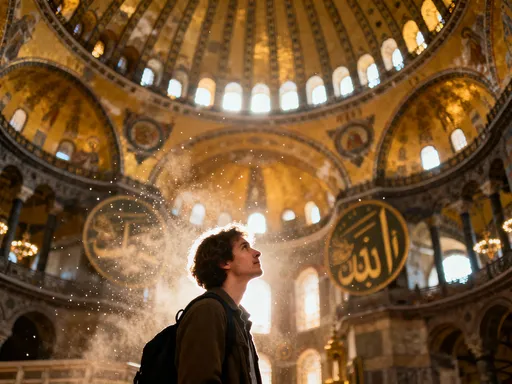
The interior of Hagia Sophia is nothing short of awe-inspiring. Forty windows encircle the base of the dome, creating a halo effect that seems to lift the entire space toward the heavens. Sunlight filters through stained glass, illuminating gold mosaics depicting Christ Pantocrator, the Virgin Mary, and various Byzantine emperors. These intricate artworks, preserved despite centuries of change, speak to a time when religious devotion and imperial power were inseparable. The scale of the interior—over 55 meters high and spanning more than 70 meters in diameter—leaves even the most seasoned travelers momentarily breathless.
After the Ottoman conquest of Constantinople in 1453, Sultan Mehmed II converted Hagia Sophia into a mosque, marking a pivotal shift in the city’s spiritual life. Minarets were added, Christian mosaics were plastered over in accordance with Islamic tradition, and Islamic calligraphy adorned the walls. In the 20th century, under the Republic of Turkey, it became a museum—a symbol of secularism and cultural dialogue. In recent years, its status has changed again, now serving as a mosque once more, though many of the Christian mosaics remain visible and protected. This ongoing transformation underscores Hagia Sophia’s role not as a static monument, but as a dynamic witness to history’s unfolding.
The Grandeur of the Süleymaniye Mosque
Rising above the Istanbul skyline from its commanding position on the Third Hill, the Süleymaniye Mosque stands as a testament to the genius of Mimar Sinan, the Ottoman Empire’s most celebrated architect. Commissioned by Sultan Süleyman the Magnificent in the 16th century, the mosque was intended to reflect the height of Ottoman power, piety, and artistic achievement. Completed in 1557, it remains one of Sinan’s most harmonious and spiritually resonant works, blending mathematical precision with profound aesthetic beauty.
The mosque’s central dome, measuring 53 meters in height and 27.5 meters in diameter, is supported by two semi-domes and a series of smaller domes, creating a cascading effect that draws the eye upward. The four slender minarets—each with multiple balconies—symbolize Süleyman’s status as the fourth sultan after the Ottoman conquest of Constantinople and his role as the tenth sultan of the empire’s entire lineage. The structure is perfectly proportioned, with every element contributing to a sense of balance and serenity. Even the acoustics were carefully engineered; the placement of hollow resonating pots within the dome enhances the clarity of the imam’s voice during prayer.
But the Süleymaniye is more than just a place of worship—it is a külliye, a complex designed to serve the community. The surrounding buildings include a hospital, a madrassa (religious school), a public kitchen that once fed the poor, a caravanserai for travelers, and public baths. This integration of spiritual, educational, and social services reflects the Ottoman vision of holistic urban life. Visitors today can still feel the quiet dignity of the courtyard, where stone arches frame views of the Golden Horn and the play of light through hundreds of windows creates a meditative atmosphere. It is a place where architecture serves not only God but also humanity.
Hidden Gems in the Backstreets of Sultanahmet
Beyond the grand monuments that draw millions of visitors each year, Istanbul’s true architectural soul can be found in the quiet corners of its old neighborhoods. Wandering through the narrow, winding streets of Sultanahmet and nearby neighborhoods like Çukurcuma or Balat, one discovers a different kind of beauty—one defined by weathered stone, intricately carved wood, and the soft glow of aged tilework. These hidden gems, often overlooked by hurried tourists, offer a more intimate glimpse into the city’s domestic and civic life across the centuries.
Historic fountains, known as sebils, dot the streets, their stone basins once providing fresh water to passersby. Many are adorned with delicate calligraphy and carved floral motifs, serving both a practical and decorative purpose. Nearby, restored konaks—Ottoman-era mansions—stand behind wrought-iron gates, their wooden façades featuring overhanging upper stories, latticed windows, and colorful eaves. These homes were once residences of wealthy merchants, officials, or foreign diplomats, and their preservation offers insight into the refined tastes and craftsmanship of the time.
Equally captivating are the centuries-old hamams, or public baths, such as the Çemberlitaş Hamamı designed by Mimar Sinan himself. Inside, the domed chambers with their star-shaped glass windows create an atmosphere of quiet contemplation. The warm, humid air, the sound of water dripping from marble slabs, and the soft glow of light filtering through translucent stone all contribute to a multisensory experience that transcends time. These spaces were not merely functional—they were social hubs where people gathered, conversed, and cleansed both body and spirit.
To truly appreciate these quieter architectural treasures, one must slow down. There is no rush here. A simple bench under a plane tree, a cup of tea at a corner café, or a moment spent admiring the pattern of Iznik tiles on a forgotten wall—these are the experiences that linger long after the trip ends. They remind us that beauty often resides not in the grandest structures, but in the details that time has gently worn.
The Allure of Istanbul’s Bosphorus Mansions
Along the shores of the Bosphorus, where Europe and Asia face each other across shimmering waters, stand the elegant wooden yalis—luxurious waterfront mansions that once housed Ottoman aristocrats, imperial officials, and wealthy merchants. Built primarily during the 18th and 19th centuries, these homes reflect a unique architectural style that blends Ottoman traditions with European influences, particularly Baroque and Neoclassical elements. Their overhanging balconies, known as cumba, project over the water, offering panoramic views and catching the cool sea breeze.
The yalis are constructed almost entirely of wood, typically chestnut or pine, with intricate joinery that requires no nails. Their façades are painted in soft pastels—creams, blues, pinks—and adorned with carved window frames, ornate eaves, and latticed shutters. Each mansion was designed to respond to the rhythms of the sea and the seasons, with large windows for summer ventilation and thick wooden walls for winter insulation. The interiors often feature high ceilings, parquet floors, and detailed wood paneling, creating a sense of warmth and refinement.
Despite their beauty, many yalis have faced threats from urban development, fires, and decay. Wooden structures are vulnerable, and the rising cost of waterfront property has led to the demolition of some historic homes in favor of modern high-rises. However, preservation efforts by cultural foundations, government agencies, and private owners have helped protect dozens of these architectural treasures. Some have been converted into museums, cultural centers, or private residences, ensuring their survival for future generations.
One of the most enchanting ways to experience the yalis is by taking a ferry ride along the Bosphorus. As the boat glides past villages like Bebek, Arnavutköy, and Emirgan, the mansions appear like storybook illustrations—sunlight dancing on their painted eaves, reflections shimmering in the water. At sunset, when the golden light bathes the hillsides and the call to prayer drifts across the strait, the scene feels almost dreamlike. These homes are not just relics—they are living symbols of a maritime lifestyle that once defined Istanbul’s elite.
Blending Old and New: Contemporary Architecture in Dialogue
While Istanbul honors its past, it is also a city that moves forward. In recent decades, architects and urban planners have sought to create modern spaces that respect the city’s historic character while meeting the needs of a growing population. This balance between preservation and innovation is evident in projects like the Istanbul Modern Art Museum, located in Karaköy, and the Zorlu Center in the Şişli district. These buildings do not imitate the past, but rather engage in a thoughtful dialogue with it.
The new Istanbul Modern, opened in 2023 in a striking design by Renzo Piano, features a lightweight, glass-and-steel structure that appears to float above the waterfront. Its transparent façade allows views of the Bosphorus and the historic peninsula, creating a visual connection between old and new. Inside, natural light floods the galleries, enhancing the experience of contemporary art without overwhelming the surrounding context. The building’s design is minimalist, yet it responds sensitively to its environment—its curves echo the flow of water, and its materials reflect the sky and sea.
Likewise, the Zorlu Center combines luxury residences, a performing arts center, high-end retail, and office space in a sleek, vertical complex. While undeniably modern, its architects incorporated subtle nods to Ottoman design, such as geometric patterns in metal screens and interior courtyards that recall traditional layouts. Even in its scale, the building was carefully planned to avoid overshadowing nearby historic sites.
Urban planning initiatives have also encouraged pedestrian-friendly zones, expanded public transportation, and green spaces that connect different eras of the city. Walking routes now link ancient sites like the Hippodrome with contemporary cultural venues, allowing visitors to experience Istanbul as a continuous narrative rather than a collection of isolated landmarks. This integration ensures that the city remains not only livable but also meaningful—a place where the past is not frozen, but actively informs the present.
Why Architectural Travel Deepens Cultural Understanding
Traveling with an eye for architecture is more than a visual experience—it is a pathway to deeper cultural understanding. Buildings are not silent backdrops; they are storytellers. A mosque’s orientation toward Mecca, a church’s east-facing altar, a mansion’s inward-facing courtyard—all reveal values, beliefs, and ways of life. When we take the time to observe these details, we begin to see a culture not through stereotypes, but through its choices in space, light, and form.
Architecture invites empathy. Standing beneath the dome of Hagia Sophia, one can almost feel the weight of centuries—the prayers whispered in Latin, Greek, and Ottoman Turkish, the footsteps of emperors and sultans, the quiet moments of reflection by ordinary people. These spaces hold memory. They remind us that civilizations rise and fall, but human creativity and devotion endure. For travelers, especially those seeking meaningful connections, such experiences foster a quiet reverence and a broader perspective.
To truly engage with Istanbul’s architecture, a few practical tips can enhance the journey. Visit sites at different times of day—early morning light brings out the texture of stone, while evening shadows reveal the play of form and space. Consider hiring a local guide who can share stories beyond the guidebooks, or simply sit quietly in a courtyard and observe. Notice the details: the pattern of a tile, the curve of an arch, the sound of wind through a window grille. These small moments accumulate into a richer understanding.
Most importantly, approach these spaces with respect. Many are still active places of worship, community, or private residence. Photography is welcome in most public areas, but silence and modest dress are appreciated in religious sites. By traveling mindfully, visitors honor not only the architecture but the people who live with it every day.
Conclusion
Istanbul’s architecture is a living archive—a continuous conversation across centuries, empires, and faiths. Its walls do not merely stand; they whisper. They speak of resilience, artistry, and the enduring human desire to create beauty and meaning. From the soaring dome of Hagia Sophia to the quiet charm of a Bosphorus mansion, each structure invites us to look beyond the surface and listen to the stories embedded in stone and wood.
For the thoughtful traveler, especially one seeking connection, reflection, and inspiration, Istanbul offers more than sights—it offers soul. It reminds us that history is not distant, but present in the arch of a doorway, the glint of a mosaic, the echo of footsteps in a courtyard. So when you walk its streets, do more than observe. Pause. Breathe. Let the city speak. Explore not just with your eyes, but with your heart and imagination. In doing so, you don’t just visit Istanbul—you become part of its story.